The Sailing Adventures of Captain George L. Thompson (1859 - 1914)
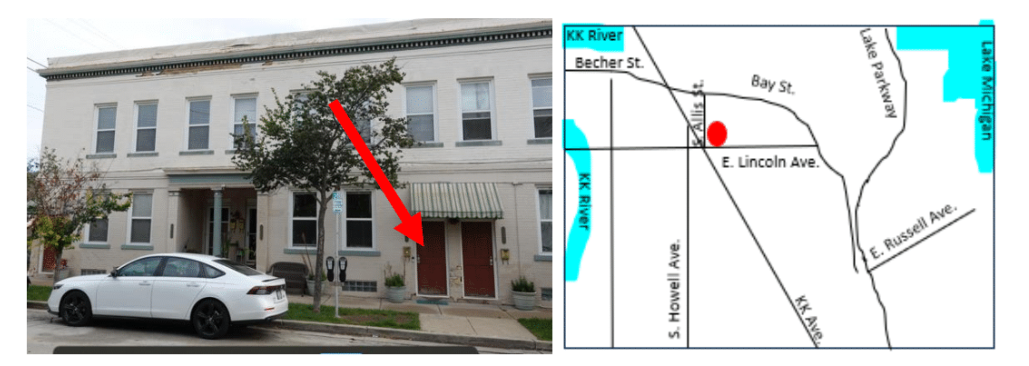
His First Home in Bay View (1898-99)
2254 South Allis Street
His Ships and Sailing Adventures While Living Here
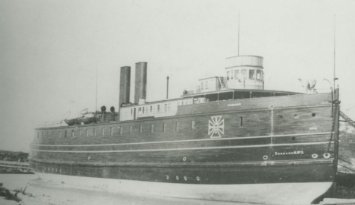
Above left: the steamship car ferry Shenango No. 2; 01 January - 08 December 1898; captain; Sailing adventures aboard as captain: On 02 February 1898, attempted to leave Muskegon for Milwaukee but turned around and went back due to ice and a heavy sea. 37 On 15 February 1898, stuck in an ice floe outside of Muskegon harbor and was carried north with the ice along the Lake Michigan shoreline. 38 On 20 May 1898, Captain Thompson reported to all Great Lakes captains that the sand bar near the entrance to the harbor at Muskegon had shifted was now gone, replaced by 16 feet of water. This shows just one of the sailing challenges faced by Great Lakes captains of the time. 39 On 20 October 1898, rammed into the American Malting Company’s grain elevator in Milwaukee harbor. Here are some excerpts from the news articles on the event: “The elevator of the American Malting Company at the bend of the channel at the entrance to the (Milwaukee) harbor stands suggestive of the leaning tower of Pisa, a monument to the artistic destructiveness of the car ferry…crowds of spectators went down to see the leaning elevator…some of the illustrated newspapers sent their artists to make sketches…The Shenango No. 2 of the Chicago and West Michigan Car Ferry (company), with her full load of twenty-six cars, was coming into port from Muskegon when…it started to turn in the basin…(the ship) failed to obey the helm (commands) and Captain Thompson signaled to the engineer (below in the engine room) to back (reverse engines). (However,) the engineer misunderstood the signal and started his engines forward and the great ship crashed into the side of the elevator, knocking it back on its foundation and, crashing a great hole on its easter side and tipping it forward (towards) the river until it is now leaning fifteen feet out of line…Capt. G. L. Thompson of the steamer tells the following of the accident: ‘I was on the bridge coming in when the helm refused to do its work and the engineer misunderstood my signal to back (up) and sent her forward. She crashed into the building with a tremendous grinding, smashing noise, and I thought that the entire building was coming over upon us. As soon as possible, we pulled out of the wreck and steamed to our dock. The steamer is not very much injured and will resume her regular trips at once’…The steamer sustained very little damage. She was built to force her way through fields of ice and came out of this accident with only about fifteen feet of the upper part of her prow carried away.” Four days later, the repairs to Shenango No. 2 were completed and resumed sailing. The American Malting Company sued the owners of the Shenango No. 2 for damages. The grain elevator was repaired and working again on 06 November. 40
Photo: Alpena County George N. Fletcher Public Library, Thunder Bay Research Collection.

Above left, center, right: the car ferry Muskegon, formerly named Shenango No. 2, 09 December 1898-1899; Sailing adventures aboard while captain: On 11 January 1899, was stranded in slush ice at the harbor entrance to Muskegon, Michigan, for about 12 hours. On 05 February 1899, was blocked for several days from entering Muskegon harbor due to ice. 41
Drawing and center photo: Alpena County George N. Fletcher Public Library, Thunder Bay Research Collection; Right photo: Edward J. Dowling Collection, University of Detroit-Mercy, Alpena County George N. Fletcher Public Library, Thunder Bay Research Collection.
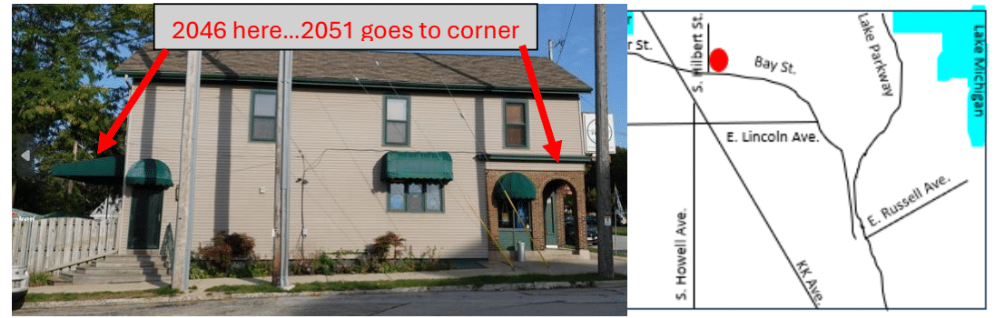
His Second Home in Bay View (1900)
2046-51 Hilbert Street, adjoining Bay St. (exact # in this range unclear)
His Ships and Sailing Adventures While Living Here
The car ferry Muskegon, 1900 (see images of ship above); Sailing adventures aboard while captain: On 16 February 1900, was delayed arriving in Muskegon for nearly a week (after departing Milwaukee) due to slush ice. 42 On 25 February 1900, finally reached Milwaukee from Muskegon after taking two days to cross Lake Michigan in a huge storm. A news report provides this account: “…with her cargo of twenty-six (railroad) cars after the roughest passage that a car ferry has ever had. The (railroad) cars on her car deck had broken loose and been badly smashed. The deck floor was broken in, car jacks and deck stanchions broken and rudder useless, but she still fought it out and though very badly damaged came to port under her own power, steering her way with her twin screws (since the rudder was knocked out). The ferry left Muskegon at 9:30 Friday night (23 February) and in mid-lake encountered the big gale which caused the damage. At 4 o’clock Saturday morning (24 February) the rudder quadrant broke and at 4 o’clock Saturday afternoon after twelve hours of incessant struggle with the waves and with the loaded cars rolling about her deck, made port at Racine. After temporary repairs she left Racine at 7 o’clock yesterday morning (25 February) and came into port at 3 o’clock like a crippled victorious warrior. The tale of the twelve hours fight with the sea and wind is a tale of hard work and heroism. The entire crew was on duty and everything possible wad done to keep the ship afloat…every man aboard was a hero and the constant labor of everyone was needed every minute during the twelve hours, and added to the work was the intense cold. The men worked under the direction of Capt. Thompson and First Mate A. T. Dority, through whose good management and seamanship the ship was saved.” 43
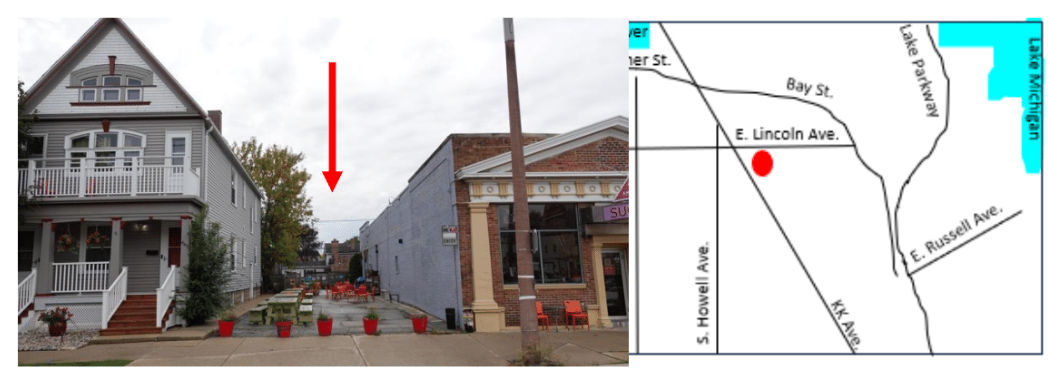
His Third Home in Bay View (1901)
447 East Lincoln Avenue
His Ships and Sailing Adventures While Living Here
The car ferry Muskegon, 01 January - 08 October 1901; the car ferry Pere Marquette No. 16, 09 October – 22 December 1901; see photos above for both ships. Sailing adventures aboard while captain: On 04 February 1901, took 16 hours to cross Lake Michigan in a huge snowstorm, recounted in a news report as follows: “After battling all night long with the fierce northeast blizzard, the car ferry Muskegon came into port (Milwaukee) this morning with her crew of twenty-eight men. They were completely exhausted by the struggle with the elements which they waged for sixteen hours, but they gave up a hearty cheer as they drew up to the dock at 7:50 (am) with their vessel uninjured after the long, hard fight. The boat was due at 3 o’clock yesterday afternoon, but was unable to enter the port on account of the terrible gale blowing and had to put out to sea, where she spent the night buffeted about by the rolling waters and waiting for the storm to moderate…the Muskegon missed her course in the blinding blizzard and dared not risk an entrance while the sea was so high. She lay just outside the harbor for some time and kept her whistle blowing but at about 4 o’clock put out into the open and did not attempt to come in until this morning. Twenty-six (railroad) cars were aboard.” 44 On 22 December 1901, ran aground on a sand bar while attempting to enter the port of Ludington, Michigan. A news report provided these details: “During a terrific winter gale from the south last night, the car ferry Pere Marquette 16, formerly the Muskegon, struck on a 13-foot (sand) bar while entering this harbor, instantly breaking her steam-pipe (instantly killing one man), which totally disabled the machinery. The boat drifted up to the north pier, where she pounded against the structure, breaking several large holes in her planking. Captain Thompson scuttled his boat in fifteen feet of water (to avoid it being broken up by the huge waves) outside the north pier where she now lies hard aground…Although Capt. Thompson knew he would have to run his boat directly in the trough of the sea in order to enter the piers, he thought he could bring her safely into the harbor as he had done many times before…but…the big car ferry rolled frightfully as she entered into the trough…she struck bottom with force. The shock brought every man on deck…the steam-pipe was broken and the boat was in a most helpless condition without light, power, or heat…At daybreak this morning, the stranded car ferry was lying about seventy feet north of the north pier…has a heavy list to starboard…the boat was completely surrounded with moving ice so that those on board had no means of escape…moreover it was bitterly cold and there was no means of heat on board…How to get the men from the doomed boat was the problem that confronted those on shore. No small boat could live an instant in the great seas that angrily hurled tons of floating ice against the weather side of the boat. But the United States life-savers were equal to the occasion. The government equips each steamer with a breeches buoy for just such emergencies as this. The (Lyle) gun was accordingly brought out and a shot line successfully carried from the shore across the deck of the stranded steamer. Those on board made the line fast and hauled out the cable, one end being made fast, meanwhile, to the pier. It was a critical moment and hundreds of spectators watched the performance with keen interest. It was at this point that the perfect training of the life-saving crew came into play. The boys had been discharged from service two weeks before, but all responded promptly to the call, the result of their work constituting what is probably the best record ever made with a breeches buoy since the apparatus was adopted for government service. One-by-one, 33 men and one corpse were brought from the car ferry and landed safely on the pier, the entire operation covering three hours. Capt. Thompson was the last man to leave the boat. He was completely broken up over his misfortune and broke down crying like a child…tugs from Milwaukee, Manistee, and Bay City had been entered and an attempt will be made to float the stranded car ferry…the steamer is completely enveloped in a casing of ice.” 45 This rescue makes George Thompson and his Bay View neighbor that was also aboard, his Second Mate Stephen Brownell (also a future Bay View lake captain), the only two Bay View lake captains documented to have ever been rescued by the famous “breeches buoy” of the US Lifesaving Service. The Pere Marquette No. 16 was indeed successfully raised a week later and began sailing again in early 1902 after repairs, George Thompson still its captain. Investigators later determined that George Thompson was not at fault and the accident had been unavoidable due to the weather conditions. 46 It should be remembered that at this time in maritime history, ships didn’t have bow and stern thrusters like they do today that greatly help turning and maintaining position in close quarters. Thompson also didn’t have any tugboats from Ludington to help him get into the harbor. See further above in the text for an actual photo taken of the crew being rescued by the breeches buoy as well as drawings depicting the buoy’s deployment to a ship in distress.
His Ships and Sailing Adventures Before Bay View
Ships he was either crew an officer aboard or captained (1877-1898) before living in Bay View
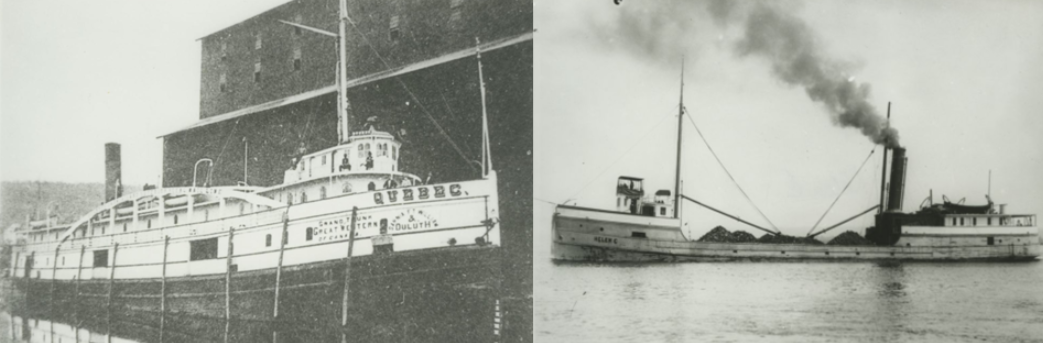
Above left: the steamer Quebec; watchman 1877, wheelsman 1878, second mate 1879; note the ship’s “trademark” external feature, the “arch” running both sides, amidships (middle)…could that be George Thompson sitting with a fellow crewman next to the pilot house?; Sailing adventures aboard as crew member: In late May 1877, reported seeing the steamer Pacific aground in Lake Michigan near the entrance of Portage Lake on the northwest coast of Michigan. 47 In early July 1877, reported seeing the steamer Francis aground at Silver Isle, Lake Superior, leaking badly. 48 In late July 1877, attempted (with help of another steamer) to pull off the steamer Cumberland that had run aground on an uncharted reef, eight miles southwest of Isle Royal in the middle of Lake Superior. The two lines snapped on both steamships with no movement of the Cumberland, forcing them to abandon it to incoming tugboats (though they also failed and the ship was abandoned). 49 In mid-October 1877, passed the sunken hulk steamship St. Louis in the middle of Lake Superior. 50 On 27 October 1878, ran aground on Magnetic Reef during a blinding snowstorm and partially sunk in the St. Mary’s River northwest of Cockburn Island on the Canadian side leading from northern Lake Huron. The St. Mary’s River connects the locks at Sault St. Marie (that lead into Lake Superior) with Lake Huron. It was this passage the Quebec was following when it hit the reef. No loss of life was reported so apparently the crew was rescued and taken off successfully. The Quebec’s cargo was substantially damaged and its “arch,” the ship’s most prominent external design feature, was broken. Two tugboats that were initially sent to help the Quebec but were themselves wrecked (one on the beach and the other sunk in nine feet of water) in the snowstorm, their crews rescued. Then a tugboat from the American side came to the aid of the Quebec but was promptly seized by Canadian officials for coming into Canadian waters. Finally, after the snowstorm subsided, the Quebec was raised and taken off the reef and then towed south to Sarnia, Ontario, for repairs to its rudder and hull. It was back sailing again two weeks later mid-December 1878, George Thompson continuing to sail aboard it as a crew member. 51
Photo: Thunder Bay Historical Museum Society, Ontario, Alpena County George N. Fletcher Public Library, Thunder Bay Research Collection.
Above right: the Quebec after being rebuilt in 1879 (with George Thompson as its second mate). Note the removal of the arch amidships as well as most of the amidships superstructure. There is nothing reported about the Quebec in 1879 other than this rebuild. Photo: Alpena County George N. Fletcher Public Library, Thunder Bay Research Collection.
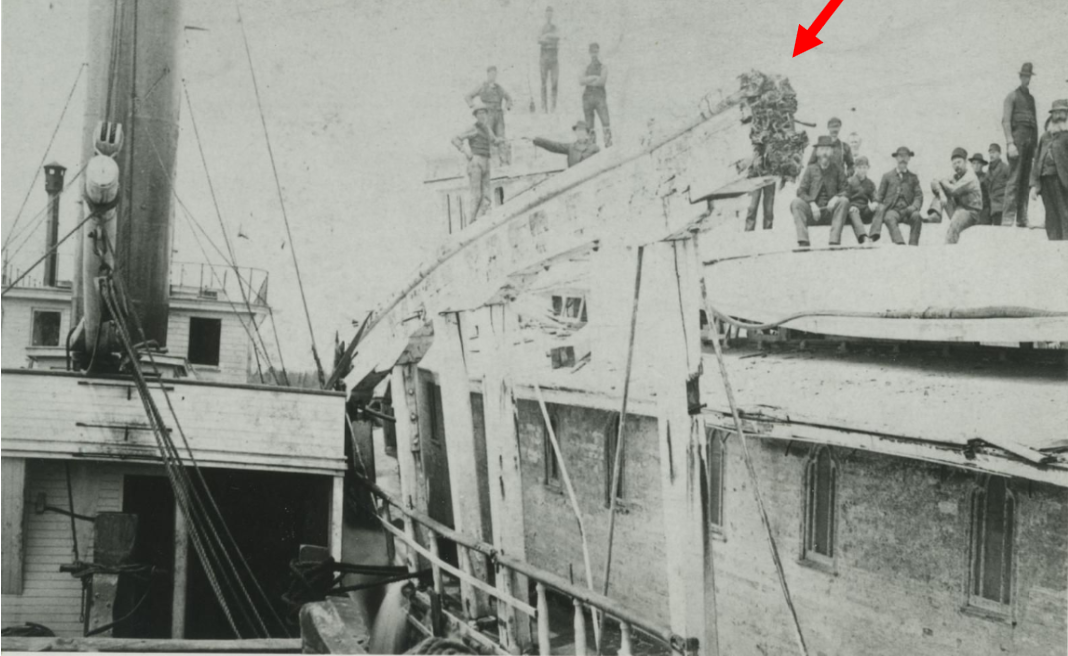
Above: the Quebec (probably) after arrival in Sarnia, Ontario, for repairs from the above-discussed accident on the Magnetic Reef on 27 October 1878. Note the broken “arch” (red arrow) and, perhaps more significantly, the undoubtedly crew members of the Quebec posing by the broken arch for this photo. It is HIGHLY LIKELY that one of these crew members is George L. Thompson, but which one is unknown. Photo credit: Central Michigan University, Alpena County George N. Fletcher Public Library, Thunder Bay Research Collection.
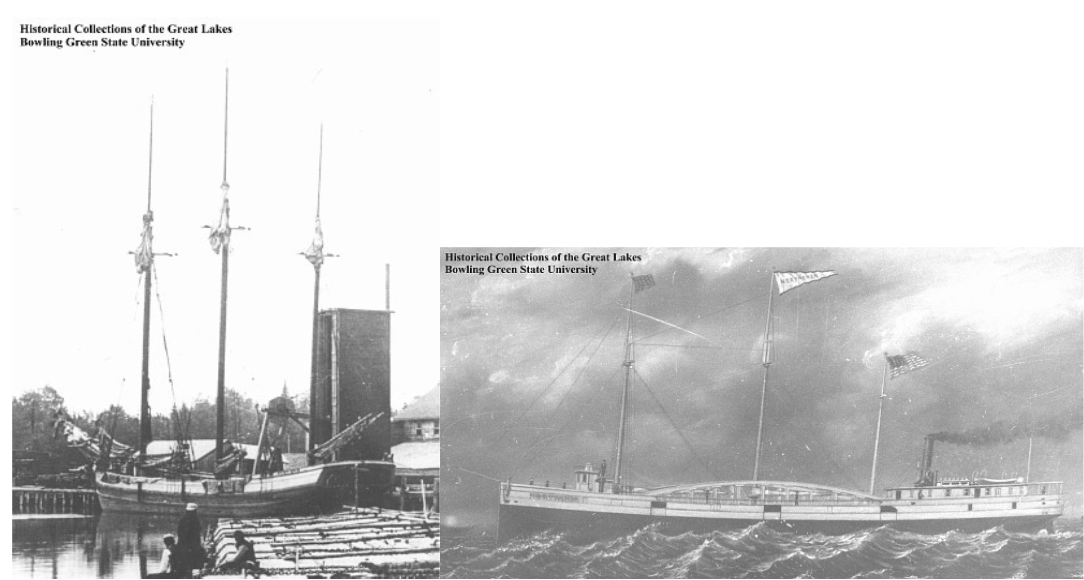
Above left: the schooner Seaman, 1880-81, seaman; Sailing adventures aboard as crew member: On 28 April 1880, carried 160,000 feet of lumber from Alpena, Michigan, to Sandusky, Ohio, under the two of the steam barge Westford. 52 On 14 September 1881, carried coal to Detroit and was held for one day by shore authorities until and when the captain paid wages due to the crew (which would have included George Thompson). 53 Photo courtesy of the Historical Collections of the Great Lakes, Bowling Green State University.
Above right: the steamship Northerner, 1882, wheelsman (note this ship had been in Eber Brock Ward’s son’s fleet three years earlier); Sailing adventures aboard as crew member: On 07 September 1882, the Northerner collided with one of the three schooners being towed by the tug William Goodnow as they passed close to each other on the Sault Ste. Marie River (that basically connects Lakes Huron and Superior). One of the schooners being towed, the George D. Russell, sank almost immediately with the loss of three lives. According to news reports, the captain of the Northerner stated his ship had been pulled into the Russell by the suction of the four ships. He also said he was on the bridge at the time and “assisted the man at the wheel to put the helm over to avoid collision. George Thompson is documented to have been the wheelsman of the Northerner in 1882, so this “man at the wheel” was highly likely to have been George Thompson. The damage to the Northerner was minor and was towed to Detroit for repairs. However besides the sinking of the Russell, the other two schooners being towed lost their jibbooms and had parts of their hulls smashed in. 54 Photo courtesy of the Historical Collections of the Great Lakes, Bowling Green State University.
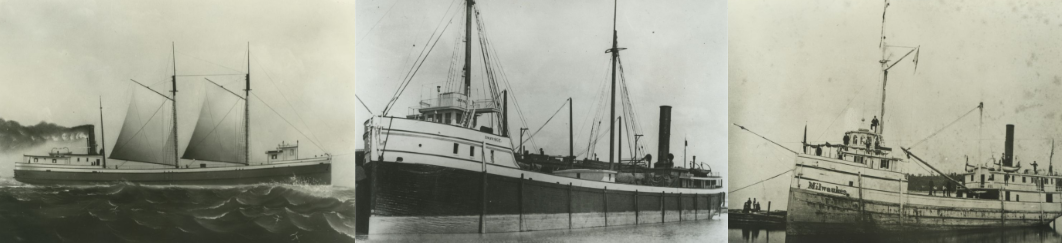
Above left: the steamship Horace B. Tuttle; 1883, wheelsman; Sailing adventures aboard as crew member: none reported. Photo courtesy the Edward J. Dowling Collection, University of Detroit-Mercy; the Alpena County George N. Fletcher Public Library, Thunder Bay Research Collection.
Above center: the steamship Iron Age, 1883, wheelsman; Sailing adventures aboard as crew member: On 30 April 1883, stuck in ice near Buffalo, New York, ice subsequently broken up by passing vessels and the Iron Age was freed. 55 On 27 July 1883, became disabled off of Fairport, Ohio, and taken in tow by a tugboat. 56 In the fall of 1883, carried grain or corn to Buffalo, returning to Duluth, Minnesota, with coal. 57 Photo courtesy the Edward J. Dowling Collection, University of Detroit-Mercy; the Alpena County George N. Fletcher Public Library, Thunder Bay Research Collection.
Above right: the steamship Milwaukee, 1884, wheelsman; Sailing adventures aboard as crew member: On 09 June 1884, collided with the breakwater in Chicago while attempting to enter the harbor in thick fog. 58 Photo courtesy H. C. Inches, the Alpena County George N. Fletcher Public Library, Thunder Bay Research Collection.
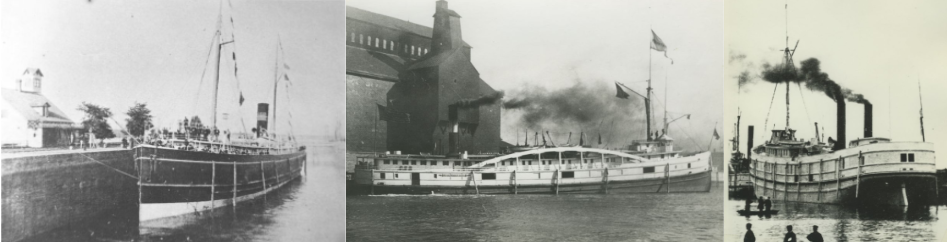
Above left: the steamship Algoma; 1885; unidentified crew member, possibly “newsboy”; Sailing adventures aboard as crew member: none reported. However, on 05 November 1885, the Algoma ran aground in a snowstorm on rocks near Isle Royale in Lake Superior with great loss of life. While George Thompson is listed in 1885 as crew on the Algoma, he is also listed that year as crew on the Fountain City. So the question is: when did he leave the Algoma for the Fountain City? Before or after the Algoma’s accident? This is not known, and the list of crewman that survived the wrecking that was published a week later in the Milwaukee Sentinel does not include him. Nevertheless, news accounts for the day weren’t always 100% accurate, so it’s possible he was aboard the Algoma when it ran on the rocks. But without definite service dates aboard – plus his omission from the “crew saved” listing published after the accident - he must be excluded from being aboard at the time. It can only be assumed that he transferred from the Algoma to the Fountain City before the Algoma ran aground on 05 November 1885. 59 Photo courtesy Kenneth Thro, the Alpena County George N. Fletcher Public Library, Thunder Bay Research Collection.
Above center: the steamship Fountain City, 1885-87; wheelsman, second mate, first mate; Sailing adventures aboard as crew member and officer: On 07 October 1885, ran aground near Detroit. 60 However, the same as above regarding the Algoma, it is unknown exactly when George Thompson came aboard the Fountain City, since he is listed only by the year of 1885 as having served aboard each. Therefore, it is possible he was aboard Fountain City during this grounding, but without knowing exactly when he left the Algoma and when he arrived on the Fountain City, it’s impossible to know if he was aboard for this grounding or not. For the 1887 sailing season, route was from Detroit to Portage Lake (northern Lake Huron) and back. 61 Photo courtesy the William MacDonald Collection, Dossin Great Lakes Museum, Detroit; the Alpena County George N. Fletcher Public Library, Thunder Bay Research Collection.
Above right: the steamship Colorado, 1888-91; second mate, first mate, and captain ; Sailing adventures aboard as officer and captain: On 12 February 1889, caught fire in Port Huron, Michigan, and had to be rebuilt. 62 On 06 September 1889, ran aground on Sleeping Bear Point at Glen Haven, Michigan, breaking both of its trademark “arches” on its hull. It was successfully released towed to Milwaukee for repairs. One news report stated that the Colorado “has a longer history of mishaps than any boat on the lakes.” 63 On 22 November 1890, ran aground on Lake George Flats near Sault Ste. Marie while carrying flour and grain. It was pulled off without incident. 64 Photo courtesy the Edward J. Dowling Collection, University of Detroit-Mercy, Thunder Bay Research Collection.
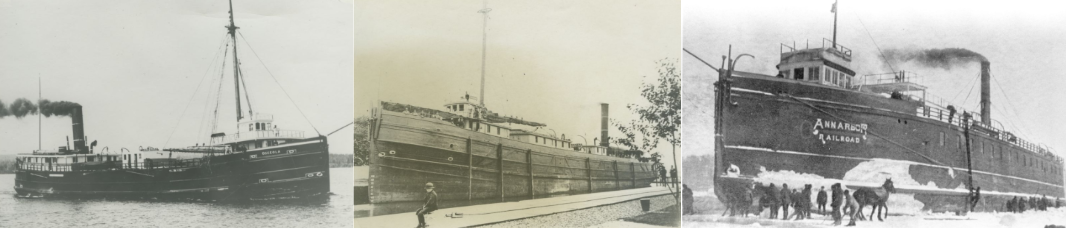
Above left: the steamship Osceola; 1891-92; captain; Sailing adventures aboard as captain: In 1891, sailing route was from Washburn, Wisconsin, to Port Huron and back. 65 In 1892, sailing route was from Kewaunee, Wisconsin, to Frankfort, Michigan. 66 In late January 1892, a fire started in the galley and a steampipe burst killing the 25 year-old engineer. Though already 15 miles out into Lake Michigan and sailing in a heavy gale, Captain Thompson (after going below to help put out the fire) decided to head back for Kewaunee, but couldn’t make it so he made for Sturgeon Bay. Unacquainted with the harbor entrance, Captain Thompson struck the pier. Though close to shore, the crew didn’t dare go out on deck because the gale was so strong they were afraid they would be washed overboard. News reporting stated that the Osceola “looked like a solid block of ice.” 67 On 02 March 1892, had its rudder damaged while sailing in ice and had to be towed to Milwaukee for repairs. Then, after the repairs, tried twice unsuccessfully to make it through the ice into Kewaunee, Wisconsin, harbor after having had to return each time to refuel with coal at Manitowoc. 68 In early November 1892, broke down in the middle of Lake Huron and had to be towed to Port Huron, Michigan, by the steamer Palmer. 69 Photo courtesy the Alpena County George N. Fletcher Library, Thunder Bay Research Collection.
Above center: the steamship Roanoke, 1893; captain; Sailing adventures aboard as captain: Unknown. There are several other captains listed in command in 1893, all involved in accidents in many news reports. It’s possible they were relieved of command after these, though that is unknown. Somewhere in 1893, George Thompson became the Roanoke’s captain but exactly when is unknown. The different accidents are therefore unknown if he was aboard or not when they occurred. The Roanoke counted several Bay View captains serving aboard it in various capacities over the winter months, but just temporarily. Thompson was the same. Photo courtesy the Edward J. Dowling Collection, University of Detroit-Mercy; the Alpena County George N. Fletcher Public Library, Thunder Bay Research Collection.
Above right: the steamship Ann Arbor No. 1, 1893-94; captain; Sailing adventures aboard as captain: because the dates of his command are not specific (only the years 1893-94) and because those years overlap with other ships he also commanded (1893, the Roanoke, and 1894, the George W. Johnson), it is not possible to decipher which sailing adventures (of which there are several reports) on Ann Arbor No 1 apply to him. Of interest, the Ann Arbor No. 1 (of which George Thompson was captain) and its sister ship Ann Arbor No. 2 were designed and built specifically to be able to be converted over to gunboats (in just 24 hours). The superstructure could be quickly removed and gun turrets placed in their pre-built areas on deck. This design, with the approval and probable guidance of the US Navy, came about as a direct response (and protest thereof) and concern about the ability and possible intentions of the British, in concert with the Canadians, to place armed vessels on the Lakes. US President Benjamin Harrison directed the Secretary of State to look into the post-war agreement. The USA considered Canada’s introduction of new armed “revenue cutters” to be an escalation after the War of 1812 that basically limited both sides to just one armed ship on the Lakes. 70 Photo courtesy Kenneth Thro, the Alpena County George N. Fletcher Public Library, Thunder Bay Research Collection.
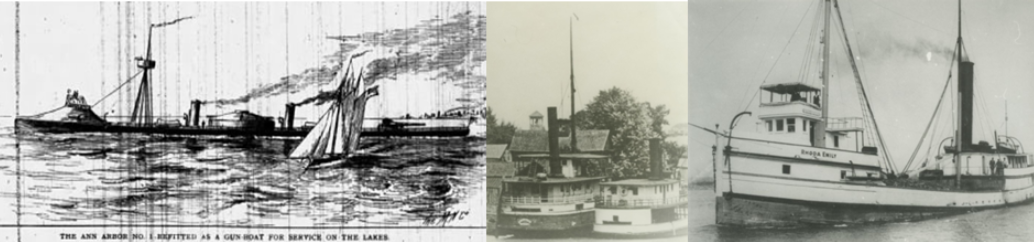
Above left: drawing of the ferry Ann Arbor No. 1 (and the same for its sister Ann Arbor No. 2) as designed and built to be quickly converted to a gunboat if the need arose. The superstructure was built so it could be removed in a matter of hours, and gun turret placed near the stern (back). The bow was strengthened to both break ice and to ram other ships during war. So technically, though it’s a stretch because neither No. 1 or No. 2 were ever converted, George Thompson, as captain of the Ann Arbor No. 1 from 1893-94, could be said to be one of the few American “gunboat” captains on the Great Lakes, or perhaps saying it better, one of the few captains of a ship designed and built specifically to be converted into a gunboat on the Lakes on 24 hours’ notice. 71 Drawing credit: Buffalo Morning Express and Illustrated Buffalo Express, Sun 15 Jan 1893, pg 3
Above center: the steamship George W. Johnson (of the two shown in the photo, it’s the one on right), 1894; captain; Sailing adventures aboard as captain: because he was also captain of the Ann Arbor No. 1 during 1894 and because the exact dates of his commands of both the Johnson and No. 1 within 1894 are unknown, it’s not possible to determine if George was captain during the one accident report found for the George W. Johnson. Photo: Edward J. Dowling Collection, University of Detroit-Mercy, Alpena County George N. Fletcher Public Library, Thunder Bay Research Collection.
Above right: the steamship Rhoda Emily, 1895; captain; Sailing adventures aboard as captain: none reported. Photo: Alpena County George N. Fletcher Public Library, Thunder Bay Research Collection.
No photo discovered: the steamship George W. Colwell, 1896; captain; Sailing adventures aboard as captain: In late May 1896, ran aground on Peshtigo Reef (near Green Bay) during a storm. It was pulled off by tugboat and taken to Manitowoc for repairs. News reports state, “It’s hull is completely filled with water and had it not been for its cargo of lumber, the boat no doubt would have sunk.” 72 Of interest, it wasn’t until nine years later a lightship was placed by the reef to warn approaching ships, and a lighthouse in 1936. 73
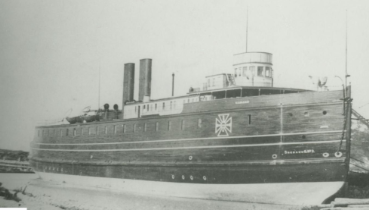
Above : the steamship car ferry Shenango No. 2; 1897; captain; Sailing adventures aboard as captain: In late December 1897, leased to begin new operations (by the Chicago and West Michigan Railroad Company) with a sailing route and schedule was to cross Lake Michigan between Milwaukee and Muskegon, Michigan, every 24 hours carrying 26 railroad cars. A dock on the Kinnickinnic River “two blocks south of Greenfield Avenue” was purchased to support the new business. 74 Photo: Alpena County George N. Fletcher Public Library, Thunder Bay Research Collection.
His Ships and Sailing Adventures After Bay View
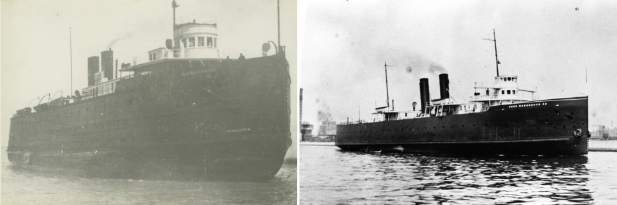
Above left: The car ferry Pere Marquette No. 16, 1902-late 1906 (see images of ship above in prior section); Sailing adventures aboard while captain: On 14 April 1902, went aground at Ludington, Michigan and had to be taken to Milwaukee for repairs that lasted two weeks. 75 On 12 February 1904, took 24 hours to cross Lake Michigan from Ludington, Michigan, to Milwaukee. Upon arrival in Milwaukee, George Thompson told the newspapers that “…the lake is practically one big ice field…” 76 Photo courtesy the Edward J. Dowling Collection, University of Detroit-Mercy; the Alpena County George N. Fletcher Public Library, Thunder Bay Research Collection.
Above right: The car ferry Pere Marquette No. 20, late 1906-? (see images of ship above in prior section); Sailing adventures aboard while captain: none reported. Photo courtesy Kenneth Thro, Alpena County George N. Fletcher Public Library Thunder Bay Research Collection.